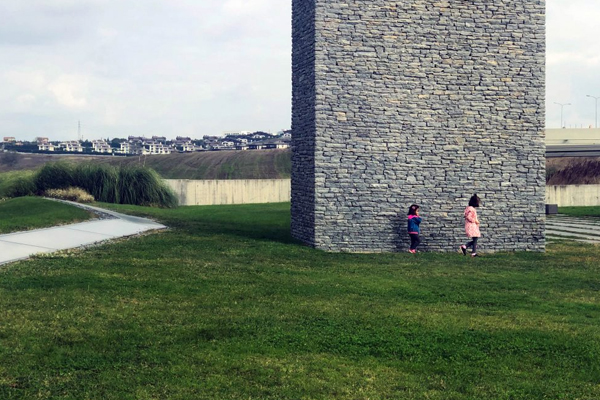
An architect friend of mine was visiting Istanbul last month and asked if it was easy to get a taxi from Taksim to Sancaklar Mosque. It is not. The mosque is almost 100 kilometers away, which means the taxi ride alone would cost a small fortune. Since I was also curious to see the building, we decided to organize a weekend minibus trip instead.
Most of the journey toward the western edge of Istanbul takes place on a highway. When you have Italian architects in the van, it is slightly embarrassing to pass developments like Venezia Mega Outlet and Emaar Toscana — “Toskana,” as they insist on spelling it. These imported fantasies line the road as if geography were optional.
Yet, despite its misplaced name, Emaar Toscana is built on a landscape that genuinely resembles Tuscany: soft hills, wide horizons, grass moving in the wind. In that sense, one could argue the name is contextual after all. Sancaklar Mosque sits within this same landscape — a calm topography that feels temporarily untouched. I say temporarily, because it is difficult to imagine these hills not becoming construction sites in the near future.
The mosque has two critical roles.
The first is immediate and spatial: it is simply a beautiful building. The interior is serene, restrained, and powerful without being theatrical. It offers what a mosque should offer — a space to withdraw, to focus, to feel grounded.
The second role is historical. Within the long lineage of mosque architecture, Sancaklar Mosque proposes a different typology. Not only for Turkey, but for the broader Muslim world. Emre Arolat found the right client and the right context to challenge expectations, and he succeeded. It is hard to imagine such an approach being realized in the dense center of the city. Perhaps it needed to be 100 kilometers away.
The building appears humble and quiet in the landscape. It does not compete with its surroundings. Yet conceptually it is radical. It speaks loudly about what a mosque can be, even if it whispers architecturally.
Some critics found it too democratic — too open, too permissive. You can walk almost anywhere. Sit. Climb. Lie down. I found this to be precisely the right approach. A mosque is not a “house of God” in the way churches are often understood. In Islam, the only sacred site is Makkah and the Kaaba. The rest of the earth can become a place of prayer as long as one faces the correct direction. There is no need for monumental formality. Modesty and clarity are enough. Here, both are present.
The typology has been challenged, and successfully so. Yet the building remains in nature, at the edge of the city. The question remains whether similar experimentation can happen within dense urban conditions. We still need new mosque typologies for the contemporary city — not only for its outskirts.