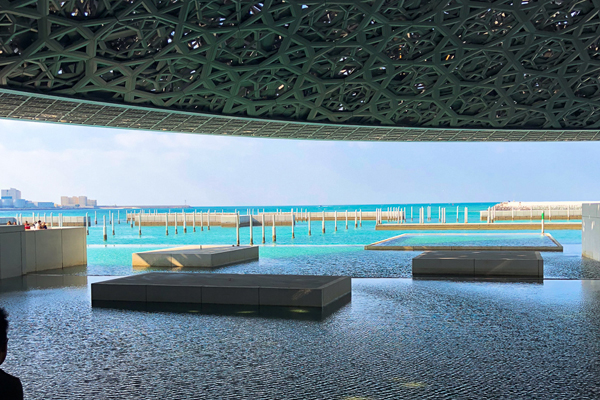
As I approach Louvre Abu Dhabi by foot, I notice three men in a small boat, right next to the bright white gallery volume that sits at the edge of the sea. They are wiping away the salt marks left where water meets concrete.
It takes energy to live with great architecture. It takes care.
You cannot leave a slice of lemon on a natural stone kitchen counter without consequence. You cannot treat beautiful clothes the same way you treat everyday laundry. Buildings of this ambition demand attention. Materials react. Surfaces age. Water leaves traces.
The Louvre Abu Dhabi may be the most beautiful building in the United Arab Emirates. Not because it is monumental, but because it offers something rare in this climate: an outdoor public realm. A shaded landscape of galleries, water, and filtered light beneath a vast perforated dome.
You move in and out of enclosed exhibition rooms and return again to the exterior. You sit under the roof. You walk along the water. The museum is not only a sequence of galleries; it is a spatial rhythm between inside and outside.
In a country where being outdoors is comfortable only seven months of the year, this shaded environment becomes more than aesthetic. It becomes civic.
The planning is simple and legible. Three clusters organize the project: the main permanent exhibition, the temporary exhibition and event spaces, and the public wing with cafeteria and services. The cafeteria is surprisingly accessible — not excessively priced — and offers a generous view toward the skyline of Abu Dhabi. Even that feels deliberate: culture without intimidation.
But what stayed with me most was not the dome. It was the men in the boat.
Great architecture does not end at completion. It continues in maintenance, in salt removal, in daily care. The meeting line between sea and building is never neutral. Someone has to return and clean it.
And that, too, is part of the architecture.