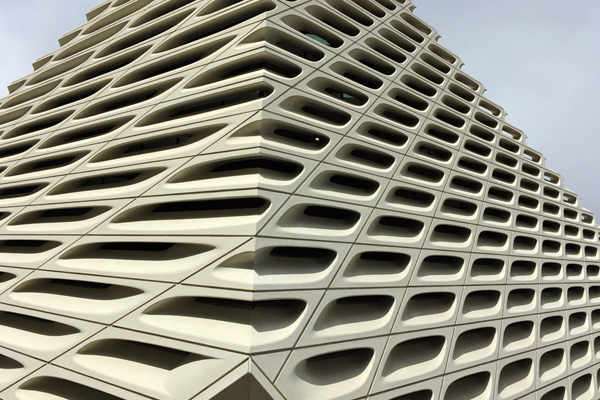
The Broad opened a month ago in downtown Los Angeles, right next to Gehry’s Walt Disney Concert Hall. In a city that rarely produces architectural moments of international clarity, this proximity alone makes the encounter unavoidable.
Designed by Diller Scofidio + Renfro — architects of the Institute of Contemporary Art in Boston and the High Line in New York — the building is their third major landmark in the United States. But in Los Angeles, context matters more than credentials.
The Broad may be the second most impressive building I have seen in Los Angeles, after my first visit to the Bonaventure Hotel. That comparison may sound strange, but both buildings understand something about interiority in this city. Los Angeles is not an easy place for a certain kind of architecture. It resists density. It resists enclosure. It resists monumentality.
The building’s skin is rigid and continuous, wrapping the facades and even folding into the ceilings at certain moments. At ground level, the space is partly civic and partly concealed. Ticketing, gathering, and circulation occupy the public zone, while back-of-house functions remain hidden. Upstairs, the entire level is dedicated to the permanent collection — a bright, evenly lit exhibition space that contrasts sharply with the heavy base below.
The archive is visible but inaccessible, sitting behind glass. It creates a strange tension: art stored, displayed yet withheld. It is not common for a museum to expose its storage so openly. The building makes the act of preservation part of the exhibition.
The ground floor feels almost cave-like, defined by thick, organic concrete surfaces. Above, everything becomes white and luminous. The contrast is deliberate — compression below, expansion above.
Unlike its neighbor, which stands as a sculptural icon, the Broad feels less solitary. It engages the street. Cafés, other museums, and pedestrian life surround it. It participates in the emerging downtown condition rather than dominating it.
In a city often defined by sprawl and spectacle, the Broad adds a different kind of presence — one based on enclosure, sequence, and interior intensity.